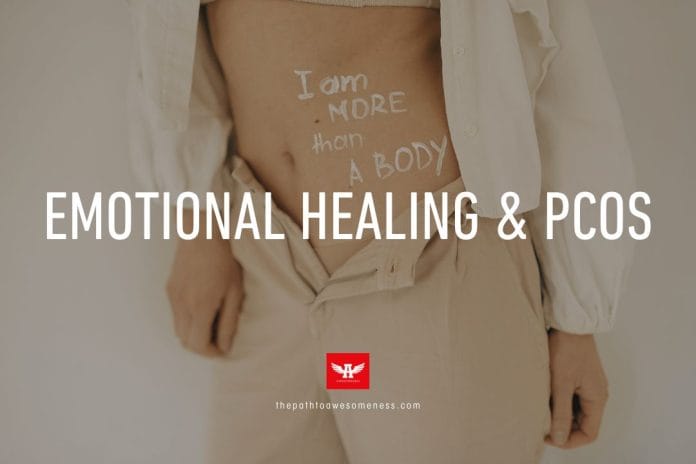
If you’ve ever cried in front of the mirror, felt disconnected from your body, or wondered why your emotions feel so out of control—this space is for you.
Living with PCOS can feel like carrying an invisible weight. You might be navigating anxiety, mood swings, frustration with your skin or cycles, or even grief over what you expected your body to be. And because so much of it lives beneath the surface, it can feel incredibly isolating.
But here’s something many people never hear: you are not just a body with symptoms—you’re a whole person, with feelings that matter.
Hormones don’t just affect your periods and your skin. They affect how you think, how you feel, and how you see yourself. And emotional stress doesn’t just live in your mind—it lives in your nervous system, your digestion, your breath, and your sleep. It’s all connected.
This post is an invitation to explore the emotional layer of PCOS with gentleness. To let yourself feel, process, and release what your body may have been holding for too long. Because when you begin to move those feelings, something else often starts to move, too—your energy, your cycles, your clarity.
Let’s begin there.
The Emotional Toll of PCOS
While PCOS is often talked about in terms of hormones and physical symptoms, what’s less acknowledged—but just as important—is the emotional weight it carries. The truth is, PCOS doesn’t just affect your body; it affects how you feel about your body, and about yourself.
Research consistently shows that people with PCOS are at a significantly higher risk for depression, anxiety, and disordered eating. And that makes sense. When your body isn’t behaving the way you expect it to—or the way society says it should—it can leave you feeling frustrated, ashamed, and deeply discouraged.
Common PCOS symptoms like hirsutism (excess hair growth), acne, hair thinning, and irregular or missing periods can chip away at self-esteem. It’s not just the symptoms themselves—it’s how they affect your sense of femininity, confidence, and identity. Feeling out of sync with your body can be emotionally exhausting.
And here’s where the cycle deepens: chronic emotional stress actually worsens hormonal imbalance. When you’re living in a state of overwhelm, your body produces more cortisol, which in turn can interfere with ovulation, insulin sensitivity, and inflammation. This creates a feedback loop where emotional distress and physical symptoms feed into each other, again and again.
But there’s hope in this awareness. Once we understand how deeply connected our emotional and hormonal health really are, we can begin to work with the body—not against it.
The next sections will guide you through how to start that emotional healing process in ways that feel nurturing, not overwhelming.
Journaling to Process PCOS-Related Emotions
Sometimes, what we most need isn’t to fix our symptoms—it’s to feel what they’re trying to tell us. Journaling is a powerful tool to begin that process. It gives shape to emotions that otherwise stay stuck in your body—like shame, grief, resentment, or frustration.
With PCOS, it’s common to carry thoughts like “My body is broken,” “I can’t trust myself,” or “Why can’t I be normal?” These beliefs often go unspoken, but they linger—shaping how we show up in our bodies and in our lives.
Writing them down is a gentle way to start meeting them with compassion.
Try These Guided Prompts:
What’s the hardest part of living in my body right now?
When do I feel most disconnected from myself?
What does my inner voice say when symptoms flare?
What have I been trying to carry all on my own?
What’s something I wish others understood about this journey?
You don’t have to write full pages. Even a few honest lines can begin to shift your emotional state and your nervous system.
Practice Emotional Reassurance Through Writing
When you feel emotionally raw or stuck, try coming back to two simple questions:
What emotion am I afraid to name right now?
What does my body need me to hear or say today?
The goal isn’t to judge or correct your answers—it’s to meet yourself with understanding. When you write with honesty, something softens. And in that softening, healing begins.
Somatic Release & Safe Self-expression
Emotions don’t just live in your thoughts—they live in your body. And when they aren’t felt or expressed, they tend to stay stuck.
This is why it’s so common to feel tension in your chest, tightness in your throat, or heaviness in your belly when you’re overwhelmed. Your body remembers everything—even when your mind tries to move on.
Somatic release is about giving your body a safe outlet to process what words alone can’t. Through movement, sound, and creativity, you help energy that’s been held—sometimes for years—begin to shift.
Ways to Gently Release Emotion from the Body
Embodied movement: This isn’t about workouts or choreography. It’s about letting your body move however it needs to—swaying, stretching, shaking, dancing slowly to a song that feels true.
Voice work: Letting out a sigh, humming, making sound while you exhale—these simple acts help open the throat and allow emotion to flow. Speaking your truth aloud (even just to yourself) can be incredibly releasing.
Creative expression: Drawing, painting, collaging, or even freeform scribbling can help emotions move in a visual, nonverbal way. You don’t need to be “artistic”—you just need to be honest.
Why This Matters for PCOS Healing
When you create safe space for feelings to move through the body, you calm your nervous system. And when your nervous system feels safe, your hormones start to regulate more easily. Cortisol drops. Digestion improves. Cycles begin to normalize.
You’re not just managing stress—you’re creating physiological conditions for healing.
So next time you feel stuck, anxious, or shut down, ask yourself: How does my body want to move this emotion out? Then trust what comes, even if it’s small.
Inner Child Healing & Shadow Exploration
For many people with PCOS, the pain of the present often echoes something deeper from the past—feelings of not being good enough, being too much, or being misunderstood. Whether it’s body shame, fertility fear, or pressure to “have it all together,” these emotional wounds often trace back to earlier experiences that never got the care they needed.
Inner child work is about gently reconnecting with the part of you that felt left out, judged, or silenced. It’s a way to offer compassion where criticism once lived—and in doing so, to create new emotional safety in your body.
Reclaiming the Shamed or Forgotten Parts of You
Think of the version of you who first felt:
Ashamed of their body
Confused by their cycle
Afraid to take up space
Silently judged or dismissed
That version of you still lives inside—and often, PCOS symptoms can stir up those old feelings. Healing means learning to listen to those younger parts, not push them away.
Simple Practices to Start This Healing
Letter to your younger self: Write to the younger version of you who first felt broken, unseen, or ashamed. Tell them what you wish someone had said. Let it be warm, honest, and tender.
Safety visualization: Imagine your younger self sitting beside you. Place your hand on your heart and softly affirm, “You are safe now. I see you. I’ve got you.”
Everyday tenderness: Choose one small way to mother or comfort yourself each day—soft pajamas, a grounding playlist, lighting a candle before bed, or saying “I love you” to your reflection.
What About Shadow Work?
Your “shadow” isn’t bad—it’s just the part of you that was never allowed to be fully seen. With PCOS, this might include:
Anger at your body
Resentment toward others who “have it easier”
Fear of not being enough
Exploring these feelings with curiosity, not judgment, allows them to soften. And when they soften, you create space for healing—not just physically, but emotionally and spiritually, too.
Building Emotional Resilience
Healing with PCOS isn’t about being positive all the time—it’s about building the emotional strength to meet yourself where you are, especially on the hard days.
It’s about learning to hold space for the anger, the sadness, the confusion, and the hope, without pushing any of it away.
Emotional resilience isn’t something you’re born with. It’s something you can grow—by practicing self-compassion, setting boundaries, and letting yourself receive support.
Practice Compassionate Self-Talk
Your inner voice matters. When it’s critical or harsh, your body stays in a state of defense. But when your self-talk is gentle and affirming, your nervous system begins to feel safer—and so does your endocrine system.
Try these reframes:
Instead of “I can’t believe I ate that,” try “I gave my body what it needed in that moment.”
Instead of “Why can’t I just get it together?” try “I’m learning what works for me, and that takes time.”
Instead of “I hate how I look,” try “My body is doing the best it can to protect me.”
These simple shifts help rebuild emotional safety from the inside out.
Set Boundaries with Shame—Internally and Externally
Whether it’s your own inner critic, a well-meaning family member, or unsolicited advice from a doctor—learning to say no to shame is powerful.
You have the right to:
Leave conversations that make you feel small
Ask for support instead of solutions
Choose care that aligns with your values—not just protocols
The way you protect your energy is a form of healing, too.
Seek Out Support That Feels Nourishing
Resilience doesn’t mean doing it all alone. In fact, isolation often makes emotional distress worse.
You might consider:
A PCOS-aware therapist or coach
Peer support groups or online communities
Friends who understand that your healing is emotional and physical
Integrating holistic mental health practices—like mindfulness, breathwork, expressive arts, or somatic therapy—with evidence-based strategies like CBT or behavioral coaching gives you a well-rounded, empowering toolkit.
This is how you build emotional resilience: not by being perfect, but by showing up for yourself again and again, with care.
FAQs
Why does PCOS make me feel so emotional?
Hormonal imbalances—especially involving insulin, cortisol, and androgens—can significantly impact your mood, stress response, and emotional regulation. On top of that, the physical symptoms of PCOS can trigger shame, frustration, and grief.
Can stress or emotions make PCOS worse?
Yes. Chronic emotional stress increases cortisol levels, which can worsen insulin resistance, disrupt ovulation, and heighten inflammation—all of which can intensify PCOS symptoms.
How do I start healing emotionally with PCOS?
Begin with gentle practices like journaling, somatic movement, inner child work, or guided breathwork. Seek support through therapy, coaching, or peer communities. Emotional healing is a process—go slow, be kind.
Is therapy helpful for PCOS?
Absolutely. A therapist (especially one familiar with chronic health or women’s health) can help you process body image issues, anxiety, depression, and more—while teaching emotional regulation tools that support your healing.
[Read the holistic guide: How to Heal PCOS Naturally]
You are not too much. You are not too sensitive. And you are definitely not alone.
Emotional healing isn’t separate from PCOS healing—it is part of it. It’s what allows your body to soften, your hormones to regulate, and your whole system to begin trusting itself again.
If this post spoke to you, take a moment to reflect. Maybe journal. Maybe breathe. Maybe just remind yourself: You’re allowed to feel everything you feel.
We’d love to hear your story—share what’s resonated, or connect with others walking this same path. Healing happens in community, too. Let’s keep going together.


